What is Mobile Commerce? How It’s Different from eCommerce?

Technology has evolved rapidly and various online mediums and methods are available to perform online transactions. Mobile commerce (mCommerce) and E-commerce have widely used terms in online commerce actively. Let’s explore each and every detail of this online commerce technology.

Table of Content
What is mCommerce
mCommerce and eCommerce
Difference between both
Go for mCommerce?
Future of mCommerce
Conclusion

What is Mobile Commerce?

Mobile commerce, widely known as mCommerce, is the process of performing online commercial transition online wirelessly via handheld devices like smartphones or tablets. In other words, M-commercial is a type of commerce where buying and selling goods, products, or services are made through the use of mobile phones rather than desktop. It allows the customer to access the online shopping platform without the use of a desktop computer and to purchase on the go.

The use of mobile commerce is rising at skyrocketing speed. According to recent estimates, mobile commerce sales account for 72.9 percent of global e-commerce revenues in 2021 which is 58.9 percent up from 2017 data. Mobile commerce sales in the United States are expected to reach $431 billion in 2022, according to industry research firm Statista. This data shows that mCommerce will be dominating all other forms of online commerce in upcoming years. Mobile commerce benefits businesses of all kinds seeking a new strategy to allow customers to purchase things. It offers several advantages for both businesses and customers. So, As a company, you must shift into mCommerce technology to compete in the global market.

Example of mCommerce:

  • Mobile Banking
  • Mobile Purchases
  • Mobile Investment
  • In-app purchases.
  • Apple pay, Android Pay, and Samsung pay.

Aren’t Mobile Commerce and eCommerce the same?

Thanks to innovative business models, customers no longer have to wait in line for hours to buy a single item. Everything you need may be purchased via mCommerce and e-commerce, but the majority of people prefer to do so via traditional commerce. Both ecommerce and mCommerce are terms used to describe the commercial transactions that take place online, as well as those that take place through specialized devices. Despite this, there are a few key differences between the two.

Major Differences between mCommerce and eCommerce

More Versatility

mCommerce is more versatile as it used a mobile phone for transactions customers can order goods from anywhere with just a click whereas for E-commerce transactions location flexibility is limited as it is It’s inconvenient to use a laptop and desktop almost everywhere or on the go. Further, retailers can also reach users practically everywhere, allowing them to get more out of mobile commerce as a result of the larger audience.

The device used

Mobile devices such as cellphones, tablets, and palmtops are used for mCommerce transactions, whereas computers are used for E-commerce transactions.

Location Tracking

An IP address is a major index used to track the location of the customer in E-commerce. The IP of the computer doesn’t provide the exact location of the shoppers in comparison to the GPS. So, it is difficult for the seller in terms of geolocation advertising methods. Due to the non-portability of computers, e-commerce’s location monitoring capabilities are limited.

Whereas mCommerce apps are integrated with GPS technology, Wi-Fi, and other methods to track valid and exact user locations. As a result, the seller can organize ads based on geo-target location. So, mCommerce apps can deliver content, and product recommendations based on the geo-targeted location of the seller. Which will benefit both the seller and the customer.

Security and Safety

According to a Statista survey, more than 30% of respondents would like to use their smartphones to pay all the time. Online purchases are now mostly paid for with digital payments and credit cards.

mCommerce apps are integrated with two-factor authentication and multi-level authentication such as biometric identification via retina scans, facial recognition, and fingerprints which is not available in E-commerce. So these security measure makes mCommerce more secure than E-commerce.

mCommerce online store

Why Mobile Commerce over eCommerce?

Mobile commerce (mCommerce) is the quickest way to stay in touch with customers since it allows anyone with a smartphone, tablet, or laptop to receive automated direct alerts that keep them abreast of the latest trends and make online transactions simple. Also, Mobile commerce has been a trending app for the last few years. So it is ideal for doing business around it.

Future of Mobile Commerce 

Although there are many commerce technology in practice, the major point is that mCommerce will undoubtedly benefit your business in the long run. Due to the existence of mCommerce, more enterprises and businesses have steadily grown with large followings and improved user experience as a result of mCommerce technology, particularly with the help of tablets, palmtops, and smartphones.

It is also estimated that By 2022, 6.9% of all retail transactions would be conducted through a mobile device. By 2025, it’s expected to be higher than 10%. According to research, about 15% of US adults are mobile users only, meaning their smartphone is their only internet-connected device. A mCommerce technology will help you reach them. This shows that mCommerce is going to be the future of electronic commerce. So, as a business owner, it’s time to shift and broaden your service to mCommerce Technology to withstand this competing world.

Takeaway

It’s a great idea to use mCommerce to improve your company’s platform. Remember that, even though they have the same names and concepts, mCommerce and e-commerce are two different things. mobile commerce is growing more quickly than e-commerce. There are a lot of ways to grow your business on the internet. Because mCommerce is the future of electronic commerce technology, it’s the best thing to choose. That being said, hire a mobile app developer to skyrocket your ecommerce business.

What is Serverless Architecture?

Managing architecture for software or a program becomes more difficult for enterprises. Software teams are more often found dedicating their time and resources to applications and their development, rather than becoming specialists in platform management. In such a scenario, using serverless architecture can be the next evolutionary step in making the entire software and application development process easier.

Table of Content
Serverless Architecture
Why Implement Serverless Architecture
Companies already adopted Serverless
Benefits of Serveless
Top Serverless Architecture Services Providers
Conclusion

What is Serverless Architecture?

The serverless architecture is a cloud-based code execution approach that enables you to build, and execute apps and services without worrying about infrastructure. Server and computer resources are managed by cloud providers rather than developers in this arrangement. The cloud service provider company will put all the code on the server where it is executed, thus there is no virtual machine or physical server. As a result, cloud providers can spin up servers to run apps, databases, and storage systems of any scale, allowing developers to write and deploy code more easily.

You as a developer don’t need to worry about scaling, managing, and maintaining servers to run your applications, databases, and storage systems, because serverless architecture is maintained, scaled, and provisioned by cloud providers. But it is essential to hire cloud developer, who has expertise on several platforms.

However, there is a misconception, that serverless doesn’t imply there is no server. It means servers are controlled by cloud service provider companies, they are simply removed from the app development process. In short, serverless architecture is the software design pattern where we host our apps on the third-party cloud server service provider rather than creating our server.

Serverless Architecture

Why Use Server Architecture?

As a developer, when you use server architecture you don’t need to worry about managing and administering servers or runtimes, you can put all your effort into the code production of the software or application. It reduces the complexity of the development process and frees up time and resources for developers to focus on creating amazing, scalable, and dependable software.

Moreover, you don’t need to take responsibility for managing and running servers. The vendor, rather than your team, is in charge of the network configuration and physical security of your servers. This is why you should use a server architecture.

Companies Adopting Serverless Architecture

  • Zalora
  • Nordstrom
  • Coca-cola-mobile
  • Codepen
  • Figma
  • MindMup
  • Netflix

Benefits of Serverless Architecture?

Serverless use has grown significantly in recent years, with about 40% of companies using it in some form. Taking a deeper look at serverless architecture’s most important advantages. Serverless architecture has a number of advantages, including the following

Easy to Deploy and Update

The serverless architecture approach can be a perfect choice if you want to get your app up and running quickly. You may now deploy an app in hours or days rather than weeks or months. The reason for this is that you will not have to worry about infrastructure. The Developers may upload code and deliver a new product in a matter of minutes, they don’t need to worry about managing servers.

Moreover, serverless architecture also allows you to update, modify, correct, or add new features to your software or program instantly. Developers do not need to make changes to the entire application; rather, they can update one function at a time.

More Time For UX

The customer and user don’t care about the backend or the infrastructure, rather they view and visualize the frontend of the software or application. They don’t have access to all the back-end code you’ve built. The front-end code will be the only thing they notice. So, serverless architecture decreases the complexity during the application development so that the developer can focus more on the UI, and UX design which will help to make customers make happy.

Cost-Effective

Serverless architecture can be a fantastic choice if you want to develop software on a low budget. Because you don’t need to design your server from the ground, rather the vendor will take care of managing, scaling, developing, and updating the server. Aside from the financial savings, serverless computing requires less processing power and human capital.

Enhanced Scalability

If your software of the app is spread and users are increased, it will be simple to make adjustments when you use the serverless to meet the expansion requirement. If that’s not the case, there’s no harm done to your app! The server service provider will automatically handle the need of your app and manage and scale the infrastructure, which won’t hamper the app’s performance. That’s a significant advantage.

Top 3 Serverless Architecture Service Providers

AWS Lambda

AWS Lambda is the most popular FaaS service provider which was launched in 2014 by Amazon Web Service. Since its launch, it has maintained the position of the leading serverless service provider on the market with the broadest range of services.

It will enable you to create independent programs in any programming language. Later coded functions can be uploaded to AWS Lambda for efficient, effective, and flexible execution. For serverless functions, AWS Lambda is a solid, all-purpose option. To stay competitive, it will almost certainly continue to develop features and integrations.

Some more information

Release: November 2014

Language support: Node.js, Python, Ruby, Java, Go, .Net Core

Pricing: The free version allows for one million requests per month, The premium version charges $0.20 for one million requests.

Maturity: Mature

Microsoft Azure

It is a serverless architecture offered by the Azure cloud ecosystem, released in 2016. Microsoft Azure Functions is a broad serverless platform designed for event-driven apps. Because Azure Functions provides a triggered-based solution, it can quickly execute a code script in response to a broader range of events. Surprisingly, Azure Functions is one of the most trustworthy serverless architecture alternatives, capable of working smoothly in higher-volume production scenarios.

Some more information

Release: November 2016

Language support: Node.js, Python, Ruby, Java, Go, .Net Core, Java, PowerShell, C#.

Pricing: Free Services are available, the pro version starts from $0.000016/GB-s

Maturity: Mature.

Google Cloud+Firebase

It is a general serverless solution developed by google in 2016 to fill the gap left by AWS Lambda a few years before. Google Cloud Functions follows the general product model, which is to provide a high-performance, stable platform for installing functions without the need for management. 

Google Cloud Functions is primarily concerned with providing a platform for serverless applications in general. It isn’t overly specialized, and its major goal is to give application developers a trustworthy target and platform for deploying serverless operations in Google’s cloud.

Some more information:

Release: 2016

Language support: Node.js,Python,Ruby,Java,Go,.Net Core, Java, 

Pricing: 2 million free requests each month, requests are charged at a per-unit fee of $0.0000004 per request (or $0.40 per million).

Maturity: Mature.

AWS and Azure, are the main competitors right now.

On a side note, Google Cloud has declined in the past few years. AWS is the most trusted and used Cloud computing platform for many enterprises. However, there is Azure on the other side which is the second most used, so now the battle is between AWS and Azure.

Conclusion

We covered Serverless architecture and its benefits, you must have got an idea of how this architecture works. It has always been a trend how big companies are always adapting to emerging tech. This is the perfect time to adapt to newer tech out there. ultroNeous provides consultation for web app development services. Inquire now for a free consultation.

What is MERN Stack? A Complete Explanation of MERN Stack

The web development industry, like technologies and frameworks, is rapidly growing. HTML and CSS were the only major languages used to construct online apps in the beginning, but the industry has progressed quickly over time. Everyone wants to pick the best and most up-to-date technology that will have a good impact on clients. When it comes to web application development, stacks are the most talked-about topic. In the construction of a great web application, picking the correct stack is crucial.

Many SaaS product startups are choosing the MERN stack for their product development. Here in this blog, we will discuss the MERN Stack and why it is the best option for Web Apps.

Table of Content

What is MERN Stack?

When coupled, the four strong web development technologies that make up the MERN stack generate much better results. When it comes to building front-end web apps, the MEAN stack relies on Angular, whereas the MERN stack relies on the React framework. MERN is a shorthand for a system that combines four different technologies in one go. They are as follows:

If we talk more about MERN Stack, it comprises

  • MongoDB
  • ExpressJS
  • ReactJS
  • NodeJS

Let’s have an overview of these four.

MongoDB

Mongodb logo

MongoDB is an open-source database management system (DBMS) that employs a document-oriented database paradigm that accommodates a wide range of data types. It is one of many non-relational database systems that emerged in the mid-2000s under the NoSQL banner for use in big data applications and other processing operations involving data that doesn’t fit well in a traditional relational paradigm. MongoDB’s design is made up of collections and documents rather than tables and rows, like in relational databases.

Features of MongoDB

  • MongoDB is document-oriented storage.
  • It has a single master with built-in replication support.
  • Ships with built-in sharding support.
  • It has very wide driver support, although databases ship with limited support, MongoDB has drivers for every language.
  • Provide horizontal scalability to balance the increasing load of modern applications.
  • Robust, flexible, and scale-able.

Express JS

Express.JS logo

Express is a Node.js web application framework that offers a comprehensive collection of functionalities for building web and mobile applications. It allows for the rapid creation of Node-based Web applications.

Features of ExpressJS

  • Allows middleware to reply to HTTP requests to be put up.
  • Defines a routing table that is used to perform different actions based on HTTP Method and URL.
  • Allows to dynamically render HTML Pages based on passing arguments to templates.
  • Develops Node.js web applications quickly and easily.
  • It’s simple to set up and personalize.
  • You can use it to make a REST API server.
  • It’s simple to connect to databases like MongoDB. 

React

React.JS logo

The most widely used JavaScript front-end library. It enables web and mobile applications to have quick and interactive user interfaces. It’s an open-source library that works with components. React is the View layer of a Model View Controller architecture, and it’s in charge of how the app appears and feels. 

Features of React

  • It works with Virtual DOM instead of Real DOM, considering that Real DOM manipulations are expensive.
  • Supports server-side rendering.
  • SEO friendly – which is an essential factor regarding online business.
  • Use of JSX – JSX makes React elegant and easy to understand.
  • Follows Unidirectional data flow or data binding.
  • Uses reusable/composable UI components to develop the view.

Hire a MERN Stack Developer

Are you looking for a modern, attention-grabbing 👀 Website? Get in touch with us 👇

Node JS

Node.js logo

An external JavaScript runtime environment that leverages the V8 engine to execute JavaScript code. It also supports server-side scripting, which includes running scripts on the server before transmitting the page to the user’s browser. As a consequence, Nodejs represents a “JavaScript everywhere” paradigm, combining server-side and client-side scripting into a single programming language.

Features of NodeJS

  • Open-source JavaScript Runtime Environment
  • Single threading – Follows a single-threaded model.
  • Data Streaming
  • Fast – Built on Google Chrome’s JavaScript Engine, Node.js has a fast code execution.
  • Highly Scalable
  • Initialize a Node.js application by typing and running the below command in the command window. Accept the standard settings.

Other Features of MERN

Efficiency: Highly efficient code with less time can be developed with MERN Stack.

Testing: It is crucial and the first string for the software development process. There is a lot of work already done for testing React.js applications, you can use many common tools such as Jest, Mocha, etc

Implementation: There is a common HTML-like, hybrid code formatting in React.js called JSX. It allows you to implement your idea more quickly. HTML-like content in the below code looks like HTML, but it is JSX.

Conclusion

This brings us to the end of the article, we discussed the MERN stack and each technology’s features. We hope that it gives you a better idea, of why the MERN stack is ideal for your startup. Hire MERN stack developer who has extensive knowledge in the field.

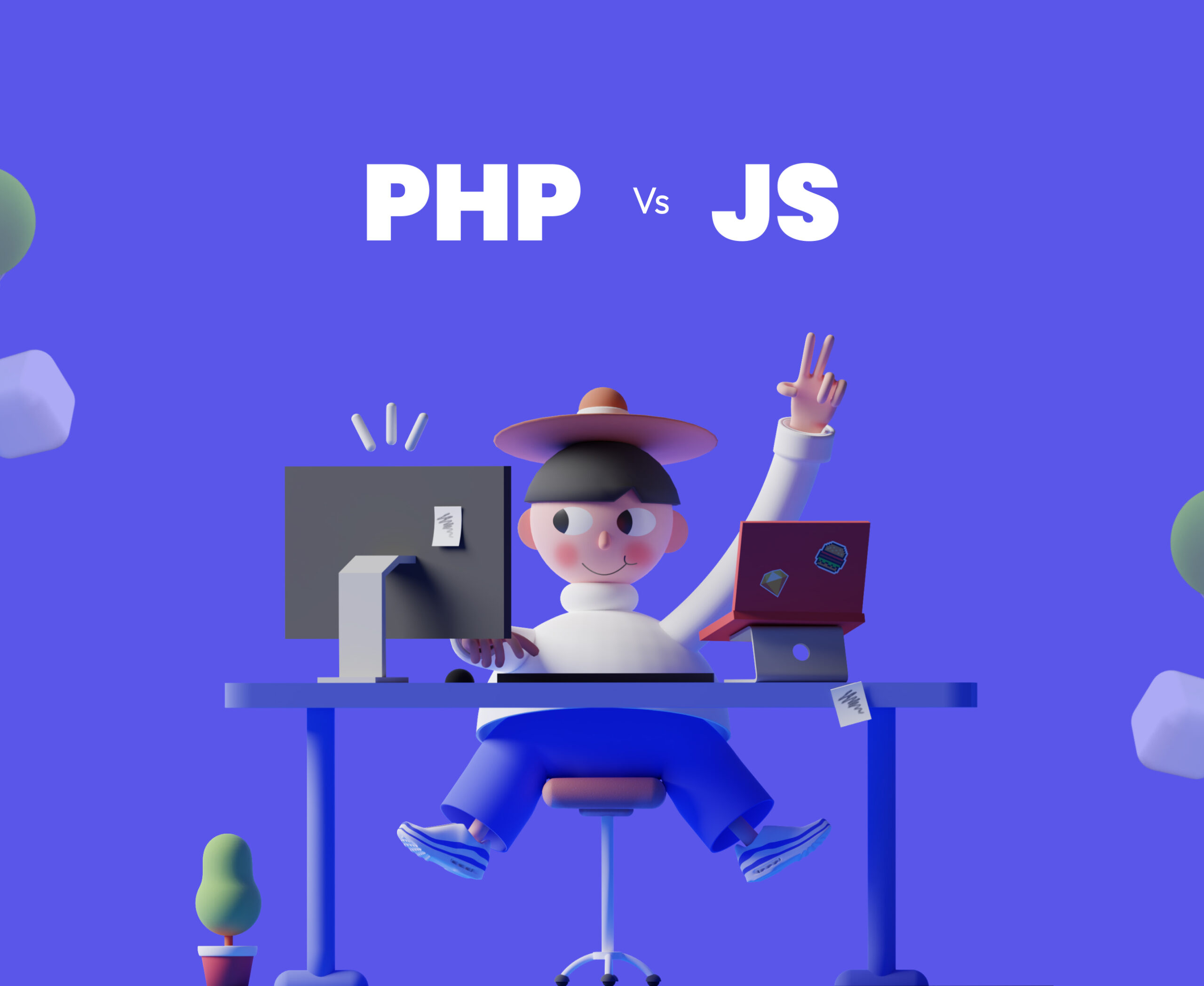
PHP vs JavaScript: Differences, how to select the best one for your project

Comparison between programming languages has been going on for years among programmers. Picking the best language is more dependent upon the project than not on the programming language. As a programmer, it’s your duty to select the best programming language for your project. When it comes to PHP and JavaScript development, they are equally important and have their own role. When we compare these programming languages for web development or web app development the answer is straightforward, PHP is a server-side language while JavaScript is a client-side language, and both of them carry equal significance. To assist developers to decide the best language for their project, here is an in-depth comparison between these languages based on various aspects.

Table of Content

Comparison between PHP and JavaScript

Performance

Centrality

Learning Curve

Developer’s Community

Database

What you can build?

Choose JavaScript if

Choose PHP if

Takeaway

Frequently Asked Questions

We have compared PHP and JavaScript on these bases

  • Performance
  • Centrality
  • Learning
  • Database
  • Community

Performance

PHP

PHP is an asynchronous programming language. So, the next line of PHP code can’t be executed before the previous line of code, making it slower than JavaScript, which is a synchronous programming language. But since the release of PHP 7, the new engine has doubled the performance and improved memory consumption. In comparison to an older version of PHP such as PHP 5.6, PHP 7 can handle twice the request and the performance has increased 2x times.

JavaScript

Unlikely PHP JavaScript is a synchronous programming language, so the block of code can be executed simultaneously, which makes it faster than PHP.

Winner: JavaScript

Centrality

PHP

PHP is a server-side scripting language used in the backend, i.e. it runs on a web server opposite to the client machine. It is useful in delivering dynamic content to the user to use, predominantly from the database. It is not compatible with the frontend, like JavaScript.

JavaScript

Since the release of Node.js, JavaScript has been a full-stack development language that can be used to create both frontend and backend of web apps, mobile apps, and desktop apps.

Winner: JavaScript

Learning Curve

PHP

As a beginner, it is easier to learn PHP development you can start learning PHP and start working on the project and soon become a PHP developer but if you are a beginner JS can be a bit tough for you and can be challenging.

JavaScript

JavaScript is a bit tough in comparison to PHP, you should have more knowledge to start learning JavaScript than PHP. Also, setting up JS is also harder than PHP. Nevertheless, JavaScript is more versatile and brighter with more value than PHP, however, JavaScript development takes a prolonged time to learn.

Winner: PHP

Developer’s Community

PHP

PHP shares about 5% of pull requests on GitHub, which means it has a good community. Companies including Wikipedia, Lyft, Slack, and 9GAG use PHP which creates a larger community among developers. Moreover, according to stackshare.io a huge advantage of learning PHP is the larger community, open resources, and simple development process.

JavaScript

JavaScript is the most popular language on GitHub, with over 18% of the pull request. The codes are open-source and easy to customize. Moreover, giant companies like Netflix, LinkedIn, Trello, Uber, Instagram, and Medius use JavaScript which proves the community is huge.

Winner: Draw 🏁

Read more: Quick Guide for Hiring Remote Developers in 2022

Database

JavaScript

There are many various frameworks of JavaScript which allow the creation of databases. Frameworks like Express JS and Vue JS are popular JS frameworks to create databases.

PHP

PHP supports a wide range of databases that can create a new database. PHP is widely popular for the purpose of making databases as it is simple, secure, and heavy databases that can be created with PHP.

Winner: Draw 🏁

Okay, so what can you build with PHP and JavaScript?

A Website

Website with PHP and JavaScript

JavaScript

JavaScript can be used to create both frontends with animation and effects, moreover various frameworks of JavaScript such as express JS, and Vue JS can be used to create a backend. So JavaScript can be used to create a full-fledged website. Although it can be used for server-side scripting but according to a report from W3tech.com  around 2% of the website uses JS as a server-side scripting language.

PHP

Because PHP cannot develop the front end of a website, it cannot produce a fully functional website. However, PHP can generate a highly secure and large database for any website. In terms of server-side scripting, PHP outperforms JavaScript, with 77.5 percent of websites using PHP and only 2 percent using JavaScript. According to a W3tech survey, the world’s most popular website uses PHP as its server-side scripting language.

Here is the report from W3tech:

Source: w3techs

Web Apps and Games

Web applications and games

JavaScript

JavaScript is versatile and can be used to create web apps like Google Maps, webmail, and web browser game.JS, and HTML5 together can create games that can run on a web browser.

PHP

PHP is not that versatile to create games and web apps, however, most games and web apps and games need a database that can be created by using PHP.

Choose JavaScript if

  • Your website is a real-time website, a streaming service like YouTube, or Netflix, or an application like a messenger.
  • Website is a single-page website
  • Website is a heavy website that needs to make frequent requests with the server to serve the information.
  • Website is fancy, consisting of high-end animations

Choose PHP if

  • A website is a blogging website or eCommerce website like Amazon, eBay, or Flipkart.
  • If you want to build a plugin for WordPress, hire a PHP developer

Takeaway

We compared both programming languages on a number of factors. In comparison, PHP is easier to learn and can create a complete backend for any website, but JavaScript is difficult to learn and can just create a frontend. Early decision is critical. Also, it is crucial to decide whether to develop on PHP or JavaScript. ultroNeous provides dedicated web development services, contact us now for a free consultation.

Frequently Asked Questions (FAQs)

What Can JavaScript Do that PHP Cannot?

The answer to the question is not straightforward, as both of them have the most similar characteristics and features. Both are better at doing certain things differently from others. However, JavaScript can be used in the frontend to create animation, UI components, popup, forms, and many more which can’t be done using PHP. As a developer, it’s your duty to choose the language wisely, depending on your project.

Is PHP easier than JavaScript?

As a beginner, learning PHP is easier and considered easy, and it doesn’t take too long to master PHP. However, if you want to put a lot of effort into a single language, JavaScript, is a long way to go. Learning and mastering JS takes a long time as it has many frameworks.

Why is JavaScript the most popular and widely used language?

According to the report from stackshare.io, the main reason behind the huge popularity of JavaScript is because of its universality (“Can be used on both backend and frontend), popularity (used everywhere from small single-page websites to complex websites), and extensibility (“There are many frameworks).

What are the key differences between JavaScript and PHP?

PHP is popularly known as a server-side scripting language, while JavaScript is popularly known as a client-side scripting language.
PHP supports databases, while JavaScript doesn’t.
PHP can’t be used to design the frontend development, whereas JavaScript can be used for frontend development.
JavaScript executes on the browser, while PHP doesn’t execute on the browser.

  • What Can JavaScript Do that PHP Cannot?

The answer to the question is not straightforward, as both of them have the most similar characteristics and features. Both are better at doing certain things differently from others. However, JavaScript can be used in the frontend to create animation, UI components, popup, forms, and many more which can’t be done using PHP. As a developer, it’s your duty to choose the language wisely, depending on your project.

  • Is PHP easier than JavaScript?

As a beginner, learning PHP is easier and considered easy, and it doesn’t take too long to master PHP. However, if you want to put a lot of effort into a single language, JavaScript, is a long way to go. Learning and mastering JS takes a long time as it has many frameworks.

  • Why is JavaScript the most popular and widely used language?

According to the report from stackshare.io, the main reason behind the huge popularity of JavaScript is because of its universality (“Can be used on both backend and frontend), popularity (used everywhere from small single-page websites to complex websites), and extensibility (“There are many frameworks).

  • What are the key differences between JavaScript and PHP?
  1. PHP is popularly known as a server-side scripting language, while JavaScript is popularly known as a client-side scripting language.
  2. PHP supports databases, while JavaScript doesn’t.
  3. PHP can’t be used to design the frontend development, whereas JavaScript can be used for frontend development.
  4. JavaScript executes on the browser, while PHP doesn’t execute on the browser.

Let’s Discuss your Idea.