Which Software Development Method Should You Use: Agile or Waterfall?

Over the last six years, businesses have intentionally transitioned from the old waterfall model to a more agile project management framework. 

According to the 15th Annual State of Agile Report, there has been an impressive increase in Agile adoption, with over 94% of respondents indicating that their business is using Agile. 
According to Goremotely.net, 71% of businesses utilize agile methodologies as their software production methodology and business project approach.

The Agile Methodology

Agile development is a continuous, team-based process. This method prioritizes the speedy delivery of web application development services in fully functional components. Instead of defining tasks and calendars, it converted into sprints.” 

Each sprint has a set period and a running list of deliverables planned at the sprint’s beginning. Deliverables are prioritized based on the customer’s company benefit. 

If the sprint’s scheduled work cannot be done, the task is reprioritized, and the data is used for future sprint planning.

As work ends, the project team and customer can examine and evaluate it using daily builds and end-of-sprint demonstrations. 

Agile requires high client participation throughout the project, notably during those assessments.

Agile Development’s Fundamental Principles

There are numerous essential principles that any agile development project will follow with this team and a time-sensitive methodology.

Adaptability: 

The need to be able to modify design, architecture, requirements, and deliverables along the process is highlighted by agile development.

Customer involvement: 

Because design and deliverable units are constantly changing, agile software development needs tight communication between the customer and the development team. 

Lean Development:

Agile development prioritizes making the result as simple as feasible. Agile development will design the software accordingly if the identical outcome can be obtained in two stages rather than five. 

Teamwork: 

Agile places a high importance on collaboration. Teams must constantly examine how they can improve their effectiveness and change the agile project as it progresses. 

Extreme Programming requires engineers to collaborate in pairs because two heads are better than one.

Time: 

Agile development approaches time during projects fundamentally differently, breaking tasks down into extremely few units of time. 

Sustainability: 

Instead of rushing to meet deadlines in exchange for an incomplete project, agile development prioritizes establishing a sustainable pace for software development.

Testing: 

Unlike waterfall approaches, which have a separate testing phase, agile methods insist on testing throughout the project. 

The Advantages of Agile Development

The Advantages of Agile Development

The advantages of agile development are all about client happiness and the ultimate result of the development project. 

The agile technique can be challenging to learn, but the effort may be worthwhile for a good development team.

Participation of stakeholders: 

Using agile mobile app development services encourages ongoing engagement between the development team and the client. 

Flexible deliverables: 

Agile allows stakeholders to prioritize deliverables. In other words, if a customer wants to release the actual product before the whole suite, agile provides for it.

Adaptability: 

We discussed adaptability as a critical component of agile development and is also one of its primary benefits. 

As clients better understand what they require from the program, the product can adjust planned sprints accordingly. 

User-friendly product: 

Because users may submit input after each sprint, agile-developed products are frequently user-friendly.

The Disadvantages of Agile Development 

The Disadvantages of Agile Development 

Intense dedication: 

Agile development works best when every team member is dedicated to the project for the duration. It may be difficult for some development businesses with a lot going on simultaneously, and it may even be difficult for individual developers.

Higher Cost:

While time-boxed sprints enable planning, it is always potential that some deliverables will fall behind schedule. 

It is a simple fact about development undertakings. Creating the required extra sprints may result in a higher project cost for the customer.

The Waterfall Methodology

The Waterfall is a method of developing linear software. The following is the order of events in this methodology:

  • Gather and document requirements
  • Design
  • Code and unit test
  • Perform system testing
  • Perform user acceptance testing (UAT)
  • Fix any issues
  • Deliver the finished product

Each represents a unique step of developing software in a simple Waterfall development project, and each stage usually completes before another one can begin. 

There is usually a stage gate between each; for example, before design can begin, the customer must evaluate and authorize requirements for Ul And UX design services.

The Advantages of the Waterfall Methodology

The Advantages of the Waterfall Methodology

Waterfall may be incorrectly labeled as “bad” or “outdated” due to the growing popularity of Agile methodologies. 

Product teams may be attracted to follow the trend and become Agile, which may not be the best option. Waterfall excels in a variety of areas, including

A well-defined framework: 

Before the project begins, there is a clear understanding of the project timeframe and deliverables. The development team and their customers agree on the whole scope of the project in advance. 

Documentation:

Each stage of the procedure is carefully documented to avoid misconceptions or shortcuts.

Shared load: 

It does not necessarily require a development team’s full attention and time. Individual team members can focus on other areas of their work based on the phase.

Hands-off approach: 

This method allows the customer to take a more hands-off attitude. There is little need for continued client presence until the review phase once the original design and project plan are in place.

The Disadvantages of the Waterfall Methodology

The Disadvantages of the Waterfall Methodology

There is no single approach to software development that will work for every team every time. The waterfall method has a few disadvantages.

Less consumer involvement: 

A hands-off approach is not appropriate for all products. As the project progresses, specific consumers will want to be more involved. 

The waterfall technique may result in frustration on both ends if there is no foundation for that involvement.

Changes can be difficult: 

The waterfall technique is designed to follow a set of procedures and a timeline. When these parts are in place, it can be tough to make modifications when the development team hits an obstacle. 

Adaptability is an important aspect of software development, especially as it might be difficult for clients.

Last-minute testing: 

Another disadvantage of Waterfall vs. agile is that it is not time-bound. While this can often result in a successful project, development projects frequently fall behind schedule. As a result, the final testing step is rushed, which may result in strongly buggy code.

Which Is The Better, Between Agile And Waterfall?

Which development technique you choose is heavily influenced by several crucial criteria. Waterfall may be the greatest solution when there is no or limited access to a consumer to provide continuous input.  It best suits projects with a dispersed crew, a specified scope, and a limited budget.

Agile is better suited to larger, more complicated projects with fast access to client feedback. The agile technique is suited for projects with constantly changing needs due to its inherent flexibility. 

“Get a custom software development service that can produce the best results using an agile approach?” ultroNeous Technologies – a software development company that can help you at every stage of the development process.”

Wrapping It Up

Once we’ve determined the core approach, we can modify the development process to best suit our project objectives. Finally, while how we conduct our work is crucial, what matters is producing a robust and maintained product that satisfies our customers.

Which development model is better: Agile or Waterfall?

The Waterfall is best suited for projects with specific deadlines and deliverables. If your key project constraints are properly known and documented, the Waterfall technique is usually the best option. The Agile methodology was developed for projects without recognized major constraints.

When would Agile be preferable to the waterfall methodology?

When the customer is unsure about the specifications or wants to be intimately involved in the software development cycle, and when timelines are short and they want speedy delivery, an Agile methodology is a better alternative. The Waterfall is preferable when dependencies are complicated, but Agile is best when dependencies are few.

Why is Agile superior to other models?

Agile teams are well-known for their ability to complete tasks quickly because Agile teams have a collaborative culture and efficiencies likely to grow. 

Look for Agile solutions that provide insights into delivery trends, allowing barriers to be removed and workflow procedures to be adapted for increased productivity.

When should we employ the waterfall model?

This approach is only utilized when the needs are well-defined, clear, and fixed. The product definition is consistent. Technology is comprehended.

Is the waterfall approach still in use?

Finding the correct methodology becomes essential while developing new software. Because many developers are shifting to newer methodologies, Waterfall is still frequently employed in traditional organizational systems and processes.


Top 10 Reasons to Trust Our Agile Mobile App Development Process

Agile Methodologies is a software development project management style that focuses on breaking down the development process into smaller builds and employing sprints, which are short development phases.

What is Agile Mobile App Development Services?

Mobile App Development Services

The Agile Methodology refers to an incremental and iterative app development approach that involves breaking the entire app development cycle into several tasks. 

The entire set of separated processes is further subdivided into a variety of sub-tasks as a separate module inside the app development team. 

Each module is assigned to a dedicated cross-functional group of professionals working on each module as an individual mini-project.

Using this agile process for mobile app development allows teams to work on different aspects of the app simultaneously. The entire project becomes a collection of little modules. 

The agile software development strategy reduces the related risk and gives developers complete freedom and flexibility in designing a high-quality product that quickly adapts to changes after delivery.

Now, Let’s examine why agile is excellent for app development and why you should utilize agile methodology.

10 Reasons to Trust Our Agile Mobile App Development Services

#1 Predictable costs

Agile approaches are meant to reduce expenses. Cost estimate methodologies are built on story points, a system that enables developers to precisely predict the budget.

To avoid wasting resources and time, only what is required is produced, including sprints, MVPs, and unit testing. Project managers and middlemen are not required to be on the team, which saves money.

Future sprints are built on earlier learnings, which leads to improved planning and, as a result, more cost reductions.

#2 Transparency

Everything is clearly stated, allowing all teams to align easily. Developers and project managers can monitor everything from concept to deployment and provide continuous feedback to the application before and after each sprint to guarantee all objectives are reached. 

Daily reports and tools are distributed to all partners to keep everyone on the same page. 

Transparent procedures enable a managed and regulated product development cycle. Project limits and blockages are addressed early on to ensure smoother delivery.

#3 Higher Quality Product

It was preferred to test the software before release. But, with agile, testing is integrated at every stage of development to ensure a high-quality end product. 

This form of ongoing inspection of every module allows for changes and decreases the probability of encountering a bug during overall project quality testing. 

It also enables mobile app developers to evaluate app elements at each stage of the development process and make changes as needed, ultimately assisting in providing high-quality services.

#4 On-time delivery

Sprint is the approach agile teams use that enables planned software development using sprints, usually of 1-4 weeks. 

The agile, iterative strategy involves brief periods when the right thing is delivered at the right time, and each team creates software gradually. 

Design and testing are done continuously to reduce Time-To-Delivery. Teams prioritize needs and streamline delivery workflows to shorten the product development cycle. 

This strategy improves the classic waterfall system. It relies on working software rather than extensive documentation.

#5 User-Centered Testing

Agile is about more than just change adaptation. The product owner collaborates closely with the team to ensure that everyone understands what is required. 

User requirements are represented in Agile software development as “user stories.” These stories define a value-added action for the customer. 

Compared to the almost lengthy list of requirements established in a standard development methodology, the concept of user stories stands out.

#6 Improved Project Management

Teams collaborate with the product owner to decide what goes into each sprint. That way, everyone on the team is on a single page about what needs to be done. 

There is also less risk of unexpected or unanticipated features making it into the build. Daily standup meetings keep everyone up to date on the state of the project, allowing concerns to be addressed immediately. 

Teams can prepare for the following sprint by holding planning meetings. These reviews assist the team in learning from previous sprints and implementing new approaches to better in future sprints.

#7 Risk reduction

Throughout the product development cycle, risk management is practiced. Once the Scrum team has identified the risks, action plans are developed. 

However, because of the default style of iterations and modifications and the entire project level, action plans are implemented and monitored continually. 

At the project’s outset, risks are identified at a higher level. Before delivery, the top prioritized risks are analyzed and mapped using checklists. 

#8 Customer Satisfaction

The project is not regarded as successful if the customer is dissatisfied and features/functions do not achieve their goal, regardless of how good the code is. Every phase should add value. 

People, particularly internal stakeholders, and customers who will utilize the final product, are prioritized over processes in agile. Customer feedback is included in the process to constantly improve quality. 

#9 Adapting To Changes Quickly

Even in later stages of development, changes critical to commercial value are adopted swiftly and collaboratively. 

Agile teams recognize that requirements will unavoidably change throughout the product development cycle. 

Because it is part of every sprint, flexibility is an excellent aspect of agile techniques. When deviations are detected, an immediate response is launched, and modifications are made. 

#10 Business ROI

Along with the primary principle of satisfying customers, business value is constantly prioritized. 

The product backlog is always available to development teams to produce the most functional, intermediate product on time. Each iteration needs user feedback, so each sprint adds value to the final product. 

The Product Owner is in charge of maximizing ROI by prioritizing and re-prioritizing the Product Backlog. Agile strategies surpass older methods and apply Android app development trends in terms of speed and ROI. 

The Types of Agile App Development

Agile App Development

Adaptive Software Development

This strategy is utilized in software projects with changing requirements and is strictly classified as short-term app projects. 

The technique employs processes such as collaboration theory and learning.

Crystal Methods

These are the techniques used to assist in the development of apps by focusing on app characteristics such as reflective improvement, frequent delivery, focus, close communication, easy access to expert users, and personal safety. 

The method works well when creating apps around people, community, interaction, talents, abilities, and communication.

Dynamic Systems Development Method (DSDM)

It is an adaptive agile development technique that ensures each step is finished just enough to proceed to the next level. It aids in the delivery of functional systems in a short period. 

This method aids in assisting frequently changing scenarios because the next level of the process may be easily put into action while not influencing the delivery process in any way.

DSDM employs tools, expertise, and procedures to aid in delivering new systems within the specified timeframe.  

Feature Driven Development

It is the model-based agile technique for the cross-platform app development process. The developers create a model at the beginning of the app project that defines multiple app features and iterations.

Scrum

Scrum is another agile software development process that employs flexible process management for large software projects. It also uses iterative and developing strategies. 

We can’t characterize the project’s final prerequisites, initially, the information is gathered using the due method from the mistakes produced in the long run. 

It only focuses on monitoring the project’s development and resolving issues that arise during regular meetings. It provides the benefits of agile methodology by assisting in taking action when the requirement changes.

“Do you require a custom software development service that can produce the best results using an agile approach?” ultroNeous Technologies – a software development company that can help you at every stage of the development process.”

Wrapping It Up

Agile software creation and assessment follow a process that allows teams to deliver a working product that adds value after each sprint. 

One of the process’s key concepts is to accept change. Agile custom software development service allows swiftly adjusting to changes in requirements without affecting release dates.

FAQs: Agile Mobile App Development Process

What is Agile in User Interface Design?

We define Agile as “an incremental approach to software development” in our Ul & UX Design Services. Rather than producing the full product simultaneously, Agile divides it into smaller sections of user functionality and assigns them to two-week cycles known as iterations.

What is the main difference between an Agile and a Waterfall mobile app?

The waterfall is a linear work approach in which the team must complete each project stage before moving on to the next. In contrast, Agile encourages the team to work on several project phases concurrently.

What are the five Agile software development stages?

The concept, construction, release, production, and retirement phases form the entire Agile software development lifecycle.

What exactly are the four Agile models?

– Individuals and interactions take priority over processes and instruments.
– Working software is preferred over extensive documentation.
– Customer collaboration is preferred above contract negotiation.
– Responding to change by following a strategy.

Why is the agile methodology the best choice for app development?

It enables you to adjust workflows at any stage of development. It allows an organization to modify any sprint with little resistance. Also, working in sprints allow you to test whether the product is progressing as expected.

How to Easily Hire MEAN Stack Developers in 2023

Easily? Yes, you read that right! It does not matter if you want to expand your team with full-stack developers or you just want developers for an ambitious project; if you follow some strategic methods, you can hire MEAN stack developers as quickly as you take a walk in a park (It’s a metaphor, Please DO NOT take it literally!) In this article, we will discuss what MEAN stack development is and how you can find and hire dedicated engineers and put action in your plans.

What Is MEAN Stack Development

MEAN stack is open-source and consists of four primary technologies-MongoDB, ExpressJS, AngularJS, and Node.js. 

This easy-to-use full-stack is for building complex software apps. JavaScript is used throughout web development, from the client to the server side, including the database. It is perfect for developing customized websites and apps.

It uses Angular.js as a front-end tier, MongoDB as a database tier, and Express.js and Node.js as a server tier. You can use Angular to create elegant and functional front-end JavaScript apps, complete with form validation, localization, and back-end communication.

Why It’s A Good Idea To Hire a MEAN Stack Developer

As you know now, MEAN stack development is significantly beneficial. Hiring a qualified and dedicated MEAN stack developer is like ending all your headaches. They take care of all your front-end and back-end needs.

1) Cost savings

You can get rid of the unnecessary cost of tools, systems, and devices that comes with hiring multiple front-end and back-end developers.

2) Assurance of Best Security Practices

Ensure your crucial data is protected against cyberattacks by hiring MEAN stack developers who follow the most advanced security techniques and acclaimed protocols.

3) Ease of Deployment

The easy deployment of mobile and web apps with MEAN stack developers is another significant benefit.

4) Code Is Isomorphic

To enable rapid loading, MEAN stack developers write isomorphic code for your server and browser to make your application respond quickly to user requests.

Responsibilities of MEAN Stack Developers

  • Creating effective apps in partnership with designers and the IT team to achieve business goals.
  • Quickly develop, test, and deploy scalable web apps.
  • Designing application features with a mobile-responsive approach.
  • Create and use development tools as required.
  • Maintenance of the cloud-based infrastructure and servers.
  • Tests of the application, bug patches, and data security and protection features.
  • Cloud app deployment and problem-solving debugging.
  • Make choices for the code’s design to enable scaling and efficient operation.

Follow These Easy Steps To Hire A MEAN Stack Developer

1) Define The Project’s Requirements

List down everything about your project’s goals and key success metrics. It will help you have a clear idea of what kind of qualities you are looking for. When searching for a qualified developer, it is necessary to narrow your search.

With MEAN stack web development, for instance, you can accelerate project delivery, facilitate MVP creation, and manage both the client and the server.

2) Choose a Hiring Model

First, let us introduce options for you. Based on your project’s requirements, you can choose either of these three options: Freelance, In-house, or outsourcing.

But everything has a catch. For instance, if you hire a freelancer, although it seems a cost-effective option, there may be a chance of a lack of security standards and in-depth expertise.

On the other hand, if you hire a developer for your in-house team, there can be time and money-consuming training and resources that goes on for god knows how long. And when you outsource it to a company, well… you put yourself in a pretty good position.

They provide expert MEAN stack developers, take care of every safety protocol, and rigorously follow industry-proven tools and techniques throughout development. It might not be an affordable option if you are dealing with a tiny budget.

3) Assess Their Technical Skills

Their skills should include those of a MEAN stack developer, such as:

  1. HTML & CSS
  2. Version control systems and DevOps
  3. JavaScript Fundamentals
  4. MongoDB- to shard, replicate, and ingest your data.
  5. Testing knowledge, Bootstrap Grid System, Typescript, Dependency injection, SPAs, and Pipes with AngularJS.
  6. The NodeJS and Express frameworks. Npm, REST, CRUD, Gulp, Grunt, Socket.io, and Node.js multiprocessing.

Also, they must be up-to-date with different technology trends to stay in pace with clients’ expectations.

4) Check their Portfolio

If you don’t ask, you will never know. Yes, you need to know your developer has the right experience. Ask them to showcase what kind of projects they have previously worked on and how they contributed to that particular project so that you can gauge their technical expertise.

And a tip is not to be blind by their diverse portfolio; instead, look for project samples that are similar to your needs.

5) Evaluate Soft Skills

You don’t want a robot working for you. You need enthusiastic and collaborative people. Interpersonal skills are essential for teamwork. There are a variety of projects that will be assigned to developers who work on MEAN stack projects.

They must be familiar with business needs. Also, they should be readily available to provide technical guidance whenever needed, along with communicating project details and progress to stakeholders.

6) Conduct the Interview

Now you can begin with the list of questionnaire preparation. To check their in-depth knowledge of the MEAN stack, narrow down questions and practical tasks according to what level of developer you will interview (junior, middle, or senior). A few standard questions you can ask:

  • Can you explain the difference between MongoDB and SQL?
  • Is there a difference between interfaces and classes?
  • How do you define “callback”?
  • How jQuery, AJAX, and Node.js differ from each other.

7) Finalize & Recruit

Based on their performance, you finalize and hire mean stack programmers to drive your business growth. Make sure they are exceptionally skilled and educated in all technical facets of the development process to avoid commercial risks.

How ultroNeous Can Be Your One-roof-solution

Whether you want a specific expert or a whole team of highly talented and dedicated experts, we as an custom software development company have various flexible engagement models according to your requirement.

Our whole team is rich with quality experiences with diverse industry domains and has a zest to develop a strategic approach tailored to your project. We offer various services, from design and development to project management and quality assurance.

Contact us and get a quote right away, and if you still need to resolve some queries, you can get in touch with our growth strategists and map out your way to success!

Hire MEAN Stack Developers: FAQs

How much does it cost to hire a MEAN stack developer?

If you have found a reliable mean stack development company then the cost won’t be too much troubling for you. According to your requirements, complexity, and developers’ expertise.

Is MEAN Stack Still Popular?

Yes, it is. Many advantages make this stack a popular choice. Apps powered by the MEAN stack are scalable and extensible. The stack is based on JavaScript. Also, interestingly, it is used to build the top 1 million websites, including Accenture, Fiverr, Uniqlo, etc.

Is it better to hire a full-stack developer?

It absolutely is. In response to changing project demands, an experienced full-stack developer can switch roles rapidly between front-end and back-end development. Despite any complexity or issue, they can solve it on their own. Their experience helps them to understand the scenarios and potential outcomes. In this manner, they can find solutions without interfering with other people’s work.

How do I hire a full-stack developer for my project?

Follow the steps that we have jotted down for you. You can use job portals, different forums, directories, and full-stack development companies to find and hire the best talent.

Can you tell me how long it takes to finish a MEAN stack project?

Each project has different sizes, types, customizations, integrations, features, and functionalities, so there is no set time for each. Rest assured, due to its robust structure; the MEAN stack reduces the time it takes to develop web apps.

What You Need to Know While Hiring Node.js Developers

Well…let’s not get into that “what is node.js” intro. (In case you don’t know: It is a widely popular JavaScript backend runtime environment)You are here because you want to hire damn good developers, and that too, as soon as possible.

But hold on to your horses; these things should not be done so quickly! Calm down; there are several factors that you need to know before, during, and after you hire node.js developers. Let’s start with “before”; first, let’s get to know what type of node.js developers are available in the market, so you can decide which option will be the best for you.

What Are The Types Of Node.Js Developers?

This is the first thing that you need to choose: engagement type. What type of contract would you like to have with your new hires? You must select a model that meets your technical and financial needs, depending on your company’s requirements and project duration. The following section will quickly guide you through the available options to Hire Node.js developers.

Hire For In-House Team

When you want to expand your in-house team or are looking for a developer for a long-term project, hiring an in-house node.js programmer is an excellent option. If you opt for this option, you must hire someone with in-depth knowledge of compatible tech stacks.

Also, keep in mind that you draw long-term financial commitment for the company. It includes the developer’s salary and mandatory benefits offered in a particular region. This model may be the best for organizations looking to expand or venture into new markets, as full-time Node.js programmers allow organizations to work on long-term strategies.

Hire A Freelancer

You don’t have to hire an in-house expert when handling a small project, as it can be cost-consuming. Short-term projects benefit most from working with freelancers. Project requirements often require technical reinforcements for small or growing organizations.

A predictable timeline can be followed for project requirements like product updates, new feature integrations, or platform migrations. Part-timers and freelancers are good choices in such situations. Hiring a freelance Node.js developer will give you access to their skills and knowledge at a reasonable price.

Outsource To A Node.Js Development Company

A proven team can also be hired to work on your Node.js project. Large enterprises and growing organizations often choose to outsource. Suppose you are a company or institution considering bringing its services/business online for the first time.

In that case, hiring a specialized service provider can offer several advantages over hiring a dedicated Node.js developer or freelancer. A lot of time is thus provided for significant stakeholders to evaluate the return on investment and efficiency of the digital solutions that have been deployed.

Finding suitable service providers depends on your organization’s financial status and goals. The process of outsourcing enables a company to hire entire teams with specialized expertise and indispensable niche specialists.

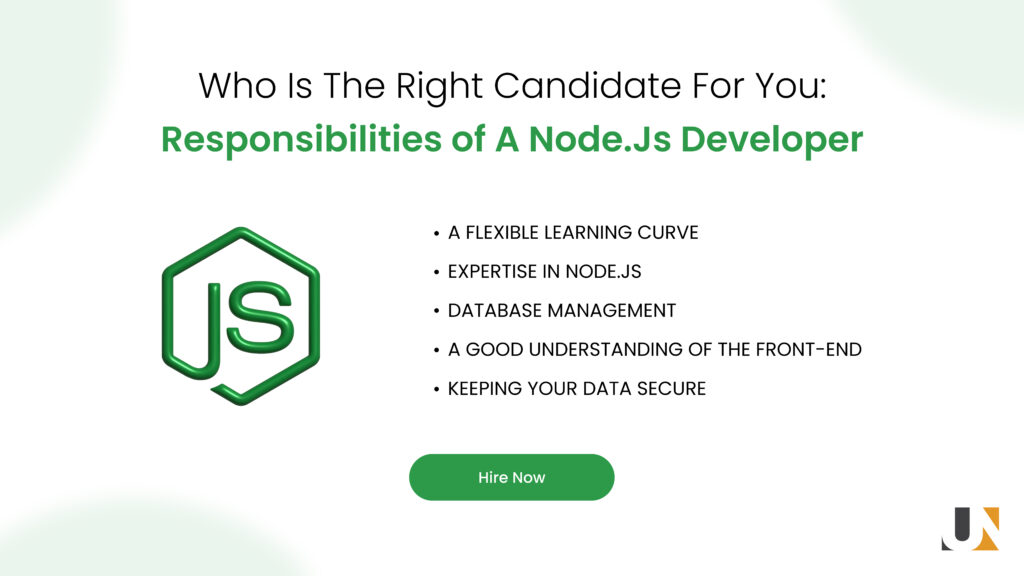
Who Is The Right Candidate For You: Responsibilities Of A Node.Js Developer

First, let’s explore what duties and responsibilities a Node.js developer has when working on a Node.js app development project to determine the most appropriate skill set.

  • Server-side logic development and database maintenance.
  • Make sure the front end is responsive to requests.
  • Data exchange between the servers and users should be made more accessible.
  • Data protection and app security should be prioritized.
  • Ensure that database queries are answered and that front-end transactions are recorded.

What You Must Know Before Hiring Node.Js Developers

Now let’s get to the things that you should know “during” and “after” hiring the best developers.

A Flexible Learning Curve

This one is essential. When you are narrowing down your search you must look for those node.js developers who have a thorough knowledge of fundamentals and are flexible enough to expand their horizons. Those with a good understanding of server-side Javascript fundamentals can easily learn Node.js. Hiring developers with experience with Node.js and who have worked with coding and testing is recommended.

The most important thing is to find developers with practical experience in coding and testing Node.js applications since that’s all that matters. Ask them to display a collection of their Node.js work, including client work, open-source contributions, or sample projects.

Expertise In Node.Js

There is no doubt that a solid understanding of Node.js programming and API development is essential. Make sure you evaluate how deep a candidate’s knowledge is. The candidates should be familiar with all Node.js versions and features. Whether they are qualified for Node.js can be assessed easier by preparing questions related to it.

Database management

This is one of the most preferred skills when hiring Node.js developers. Consider the SQL knowledge of candidates and whether they can manage multiple databases and merge them.

A Good Understanding Of The Front-End

An understanding of HTML5 and CSS3 technologies is desirable and potentially valuable during the collaboration process. To improve the user experience of the app interface, Node.js developers should also examine the front-end part of the code.

Keeping Your Data Secure

Security is becoming increasingly important as malware and data breaches increase. Understanding how to provide secure authentication and use encryption wisely is vital for your hired node.js developers.

What Cloud Platforms Are They Familiar With?

There are multiple benefits to deploying web applications on the Cloud, so we seek talent with experience working with the top cloud platforms.

Node.js applications commonly run on these cloud platforms –

  1. The deployment of your application couldn’t be more straightforward with Elastic Beanstalk for deploying and managing scale and Lambda for serverless hosting on Amazon Web Services (AWS).
  2. Cloud platforms are going to be dominated by Microsoft Azure shortly. It offers one of the most efficient services available today in terms of building, deploying, and scaling applications.
  3. For running Node.js applications in containers, Google Cloud offers low latency networks, its PaaS service ‘App Engine,’ and its Kubernetes Engine.
  4. The Heroku platform offers free Node.js hosting, seamless integration with 3rd parties, and detailed documentation to make it easier for beginners to get started.
  5. As a developer-friendly cloud platform, Netlify delivers a drag-and-drop feature for faster deployments and lets developers import components straight from Git repositories.

Have They Worked With Alternative Package Managers?

Node.js uses open-source, well-tested packages that reduce code rewrites and encourage faster development. Node.js developers use different package managers to manage these packages. Make sure the candidate you hire has a good understanding of npm—the default package manager for node.js. Ask them about the alternatives to npm to get better answers.

Yarn is one of the most popular alternative package managers for node.js apps. Yarn installs a package much faster than npm by using local cache memory. It also installs packages parallel and queues network requests to optimize the entire network. Pnpm is another popular alternative package manager.

Developers praise it for solving the problem of NPM doppelgangers. Pnpm installs all the needed packages on disk with a hard link to the node module directory. This saves disk space significantly.

Hire Dedicated Node.js Developers: FAQ

How complicated is the process of hiring node.js developers?

Finding experienced and knowledgeable Node.js developers can be tricky, especially when competing against thousands of other companies. It can be easier to find junior developers depending on their seniority, but if you’re looking for a senior engineer, you’ll have to fight for them. If you’re looking for an experienced Node.js developer, you’ll need to research them on different local and international platforms. But it would be like a piece of cake if you have already found a reliable technology partner.

How to Hire the Best Node.js Developers?

If you haven’t hired a professional developer before, here are some things to remember:

1. Make sure you have a list of everything you need to know and have all the necessary qualifications.
2. Focus on soft and hard skills, as their time management skills and ability to be collaborative and devoted team members will make a big difference.
3. Prepare a technical task, as it will determine the success of your project.
4. Get Professional Help from a Software Development Partner.

Software development partners have great experience finding candidates with the proper knowledge and skills. You’ll get the professionals you need and save time and energy that can be put into your business development strategies.

How to Hire Node.js Developers in 2023

Let’s face it. When you want your idea/product or boost the project development process, you need a reliable team who can perform an architecture assessment, create solution designs, report on risks and limitations, and supply improvement roadmaps. You must have a perfect combination of front-end and back-end technologies, such as Node.js.

This JavaScript runtime environment enables developers to create robust and reliable web apps. According to the Stack Overflow Developer Survey, Node.js is one of the most desired development frameworks. In addition to enabling fast and lightweight JavaScript processing on the front end, Node.js simplifies the development of flexible and scalable servers.

As we all know how complicated it is to develop maintainable apps, it is even more challenging to find and hire node.js developers who understand your requirements thoroughly and know their way around to build complex web apps for your accelerated growth. So without any further ado, let’s dive deep into this guide on how you can hire node.js developers and what things you must keep in check.

Why Use Node.js for your project?

With Node.js, you can build real-time web apps across multiple devices. The open-source framework makes it easy to develop server-side apps and integrates well with JavaScript on the client side. Being highly performant and cost-effective, Node.js allows developers to build various apps covering almost every industry and technology. Some of the benefits of using Node.js include:

Full-Stack Development

While using node.js you can take advantage of JavaScript as much as possible because client-side and server-side development is done with a single codebase (obviously, JavaScript). It enables easier integration and communication to smoothen the development process and reduces developer count (you don’t need to hire too many developers; isn’t that sound like a relief?

Scalability

Scalability was a key consideration when Node.js was built. Your applications can be scaled horizontally – by adding machines – and vertically – by upgrading them. Node’s cluster module is also available for developers to use the CPU for parallel processing.

Performance

Ryan Dahl developed Node.js on Google Chrome’s V8 JavaScript Engine (in 2009, and no, it did not get popular overnight!). It operates on a non-blocking, event-driven I/O model. As a result, it is efficient and lightweight since all functions are executed asynchronously without blocking other requests.

Budget

Node.js runs much faster and consumes less computing power than comparable frameworks. It saves precious dollars better spent on talent recruitment and technology diversification.

Cross-functionality

It is not only used to develop RESTful APIs but also widely used in real-time apps, IoT apps, chatbots, and collaboration tools like Slack And Trello.

SEO-friendly

The Node backend renders websites in a way that maximizes their visibility in search engines, boosting their SEO rankings. And that is the reason why organizations where SEO is a top-most priority; node.js is used to make their web pages more SEO-friendly.

What Are The Responsibilities Of A Node.Js Developer?

Node.Js Development services

Node.js developers specialize in building network apps. Ideally, they should be familiar with JavaScript’s core and its various libraries. And their work often involves:

  • Integrating web-based apps.
  • Easing data exchange between servers and users.
  • Developing back-end components in partnership with front-end developers.

As per your specific project requirements, you can hire Node.js developers. If we summarize everything in a few points, an ideal hire would have the following responsibilities:

  • The code they write must be clean, robust, and reusable
  • Server-side component development and maintenance  
  • Components on both the server and client sides must be integrated.
  • Determine the best solution for data storage
  • Best practices for data protection and cybersecurity should be incorporated.
  • Diagnose bugs, fix them, and provide technical support to users 
  • The entire software development process should be documented.

While we know you want the best talent for your precious projects or team expansion, you need to understand that for a small project, it is not good to hire senior-level Node.js developers. They might feel disconnected if they do not feel as energized and challenged as dealing with complex projects.

The Skills You Need To Check Before Hiring A Node.Js Developer

As your project demands the absolute highest quality, you must hire node.js programmers with the right technical expertise and soft skills, so they can convey themselves properly. 

HTML and CSS Expertise

This is a basic requirement for hiring any web developer. You may think that isn’t JavaScript’s more crucial factor. Yes, of course, it is, but understanding technologies like HTML and CSS is the backbone of development. These technologies turn out to be extremely valuable in designing reliable back-end programs compatible with front-end applications.

Node.js Expertise

Okay, This one goes without saying. The developer you want to hire must have an excellent portfolio of Node.js (even junior developers should have contributed to some Node.js projects) so you can quickly gauge how they will align with your project. If they have experience contributing to the Node.js community, that should be considered a plus.

This is necessary as they will work as part of your development team, so when you get a node.js programmer with prior experience in collaborating with a team and developing tailored apps, your dream to have a seamless procedure can take shape on its own.

Experience With Node.js Frameworks

To extend the functionality and features of Node.js, frameworks are essential. It is important to hire Node.js developers who understand the frameworks used by your project.

An understanding of RESTful APIs

It is common for Node.js developers to have to deal with API integration between various projects. They can exchange data more efficiently between different apps when familiar with RESTful APIs.

Communication & Coordination (teamwork)

Teamwork makes the development process more efficient and effective. Open-minded and collaborative Node.js developers take individual responsibility for their work and adopt a team-oriented approach.

The performance of a Node.js developer on the team can be greatly improved by having proficient written and oral communication skills. It allows clients to connect smoothly and team members to share concerns and feedback without feeling awkward.

Competency In Problem-solving

Node.js developers must have a good understanding of error diagnosis and syntax manipulation, in addition to good problem-solving skills.

The Steps To Hire Node.Js Developers

This section will walk you through each hiring process step for choosing the right candidate, whether you are building a new app or expanding your development team.

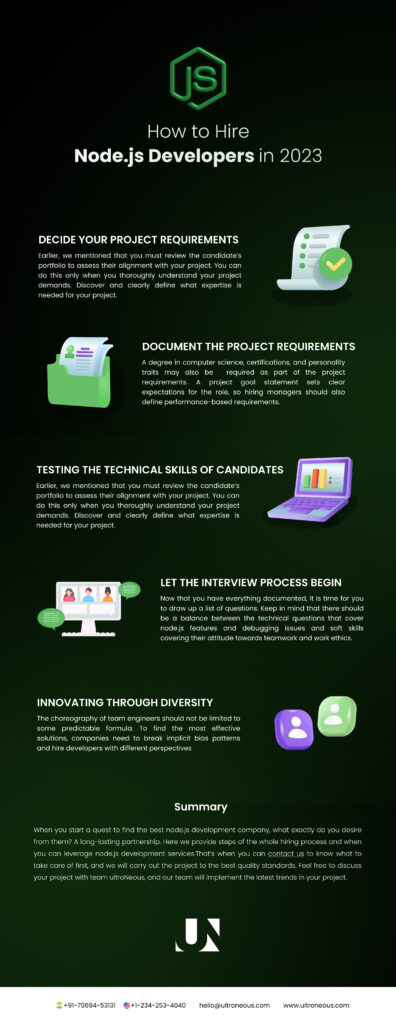
1) Decide Your Project Requirements And What Core Skills You Are Looking For

Earlier, we mentioned that you must review the candidate’s portfolio to assess their alignment with your project. You can do this only when you thoroughly understand your project demands. Discover and clearly define what expertise is needed for your project.

Build an ideal hiree profile, with how many years of experience in the industry and whether or not their fundamentals are clear. A Node.js engineer must have a concrete understanding of JavaScript, Node.js modules, efficiency in troubleshooting errors and bugs, and API communications. Experience with Node.js standard library methods and database management can also benefit the company.

2) Document The Project Requirements

A degree in computer science, certifications, and personality traits may also be required as part of the project requirements. A project goal statement sets clear expectations for the role, so hiring managers should also define performance-based requirements.

3) Testing The Technical Skills Of Candidates

It is common for companies to use third-party code-testing platforms, such as HackerRank, CodinGame, or TestGorilla, or to customize their skills assessment. Another option is to hire pre-vetted Node.js developers through platforms.

4) Let The Interview Process Begin

Now that you have everything documented, it is time for you to draw up a list of questions. Keep in mind that there should be a balance between the technical questions that cover node.js features and debugging issues and soft skills covering their attitude towards teamwork and work ethics.

5) Innovating Through Diversity

The choreography of team engineers should not be limited to some predictable formula. To find the most effective solutions, companies need to break implicit bias patterns and hire developers with different perspectives. You can develop fresh ideas, solve problems, and unleash creativity by fostering diversity.

When You Should Opt For Node.js

API Servers

Node.js enables developers to handle multiple concurrent connections simultaneously, making it easy to convert JavaScript objects in JSON format.

Real-time Apps

As mentioned earlier, you can leverage node.js to power real-time apps with a high volume of short messages requiring minimum delay. 

Data Streaming

Node.js has an asynchronous nature, which is really good for streaming media and data from numerous data points, resources, and apps involving multiple file uploads. (Netflix comes to mind here!)

The Secret Sauce

When you start a quest to find the best node.js development company, what exactly do you desire from them? A long-lasting partnership. Here we provided steps of the whole hiring process and when you can leverage node.js development services. Now that you have a clear idea of how to handle hiring, you need to know that everything does not go as smoothly as you may have imagined. That’s when you can contact us to know what to take care of first, and we will carry out the project to the best quality standards. Feel free to discuss your project with team ultroNeous, and our team will implement the latest trends in your project.

Hire Node.js Developers: FAQs

How much does it cost to hire a node.js developer?

When determining the cost of hiring node.js developers, numerous variables come into the picture. As every project is unique, the factors vary, like the amount of time, expertise, and effort that goes into the complexity and UI/UX design for scaling your project.

Is node.js still in demand?

Node.js will be a massive trend in web development in 2023 and the future. It offers significant benefits, making it the best option for software development. It is light weighted, fast, has availability for many hosting service providers, and has an open-source community.

What Companies Already Use Node.js?

The following companies use Node.js: PayPal, LinkedIn, Trello, Walmart, Uber, Netflix, Twitter, eBay, and Yahoo, all of which showed better results than before.

Where do I find node.js developers?

LinkedIn, freelancing platforms, job boards, and outsourcing agencies are good places to find Node.js developers.

Hire Flutter App Developers & Release Your App Faster

Google released Flutter in 2018, and since then, this open-source software development kit has gained popularity among developers with its numerous features. According to Statista, Flutter has become global developers’ most popular cross-platform development technology; 42% of software developers used it in 2021. As the tech industry constantly evolves, startup founders and established enterprises are looking to develop digital products in less time and faster time to market. When you want to hire Flutter developers and leverage all those benefits then let’s start with what Flutter brings to your table.

Why You Need To Use Flutter For Faster App Development

hire flutter developers

Single Codebase

In native app development, Developers need to have a thorough knowledge of various native programming languages like Swift, Java, JavaScript, Kotlin, Objective-C, and know-around of app stores. But Flutter is not like that. Developers have to know the workings of only one language: Dart. It has gained momentum with its solid features of object-oriented programming languages.

Hot Reload

Running apps is one of the most time-consuming parts of developing them. In iOS, for instance, saving, compiling, and viewing the code takes 10 to 30 seconds. But Flutter is different. Thanks to the hot reload feature, developers can update the code, hit the save button, and implement and see changes seamlessly. It allows them to customize the app’s color, buttons, and other UI design changes. Flutter also makes it easy to debug, update, and maintain codes.

High Performance

Apps built using Flutter provide the look and feel of native apps. This SDK comes with widgets similar to those found in iOS and Android apps. Since Dart compiles to native code (as Flutter does), it does not require OEM widgets. As its engine communicates directly with native modules, its performance is fast and stable.

Reduced Time To Market

It is possible to develop iOS and Android apps with Flutter in less time than with native development. Creating a user interface (UI) with Flutter is easy and flexible, making it a highly efficient and cost-effective platform for developing apps. By leveraging a single codebase, product releases can be made faster and time to market reduced.

Source Code Accessibility

Flutter development provides a great deal of flexibility in customization. You can view the original code written by the team by clicking on the code. The widgets’ workings will also be clearer to you. Compared to proprietary iOS code, the Flutter toolkit allows you to customize a design or template. You can modify the button’s shape, color, and dimensions by editing its code.

Adaptable Layouts

With Flutter’s flexible layout system, you can create an impressive user interface. It is common for developers to encounter a challenge when creating apps:

How to design a layout suitable for various screen sizes? It utilizes widgets such as rows, columns, stacks, and centers to make Flutter’s layout compatible across devices. Stacking elements horizontally, vertically, and on top of one another is accomplished through this step. Padding, center alignment, and margins can also be adjusted using it. Hire Flutter App Developers who know their way around these benefits and boost your app development process.

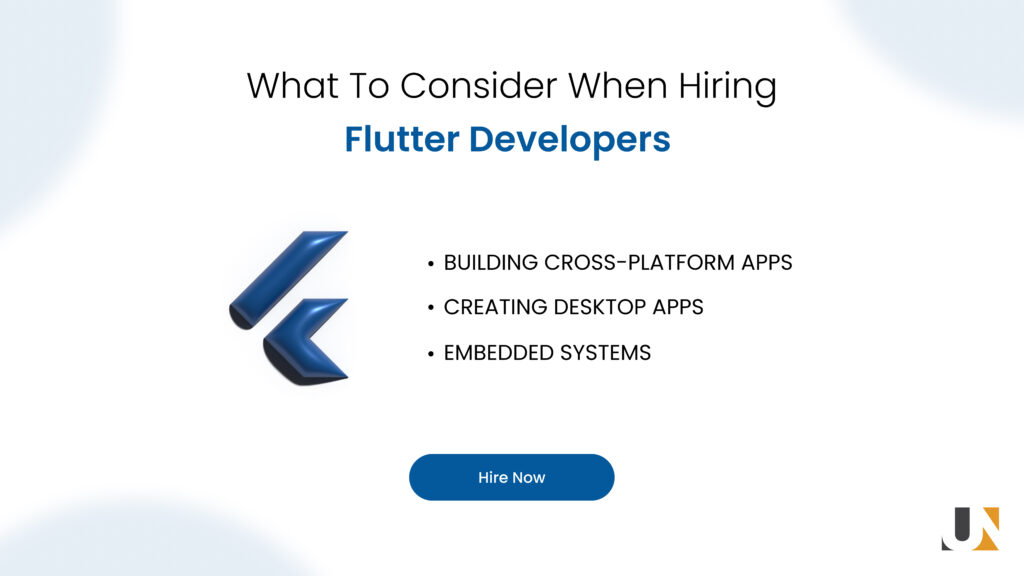
What To Consider When Hiring Flutter Developers

hire dedicated flutter developers

If you’re looking to hire a Flutter app developer, it’s important to understand their responsibilities. Flutter developers are responsible for creating apps that work seamlessly across multiple devices. 

Here’s a breakdown of the different platforms they work with:

Creating Desktop Apps

Flutter app developers work not only on mobile apps but also on creating desktop apps. The added advantage is that it allows your startup to extend its reach and cater to desktop users.

Embedded Systems

Flutter provides the ability to integrate developers’ work with components written in other languages, providing a clean interface and portable code. This opens up opportunities for your startup to work on projects that require embedded software development services.

Stay Updated With Technology

Keeping up with the latest trends in technology and innovation is vital in today’s fast-paced world. Despite being relatively new to the scene, Flutter has already captured developers’ attention globally.

Many standalone Flutter development services are available for companies that don’t want to hire in-house Flutter engineers. At Waverley, we have been working with Flutter for several years. Our engineers are passionate advocates of this tool, always staying up-to-date with the latest developments and trends.

Security

When it comes to developing apps, security cannot be ignored. Flutter developers are responsible for implementing robust security measures, minimizing dependencies, and ensuring proper data encryption techniques are used.

The Code Has To Be Maintainable And Needs To Run Smoothly

As a Flutter app development company, we know how important it is to maintain the highest quality and performance. Our rigorous quality management system includes peer code reviews, comprehensive unit testing, and test automation. We minimize technical debt, provide regular training and project health checks, and more.

To create clear, maintainable code for Flutter, we recommend following a few tips, such as refactoring the code into widgets, using state management, and following a well-defined architecture. Following the Dart Style guide is essential to create effective code. With these practices in place, you can ensure that your apps work great and stand the test of time.

Remote vs. Freelance: Which Flutter Developer Should I Opt For?

Differentiating between remote developers and freelancers can be confusing, and many people are unsure whether independent contractors can be considered remote developers. However, there are significant differences between hiring freelancers and remote programmers from different companies.

Companies must understand the difference between freelancers and remote workers to virtualize their work procedures. A remote team can boost productivity, efficiency, and work quality, making them ideal for long-term initiatives. On the other hand, freelancers are more suited for short-term and smaller projects.

The right option for your project depends on the pros and cons of both hiring methods, whether it’s remote developers or freelancers. For startups, embracing remote work as a long-term strategy can help maintain competitiveness in the ever-evolving digital landscape. With remote employment, businesses can expand their team easily and affordably while attracting top talent. In both cases, companies should prioritize easy and efficient communication and provide KPIs to gauge the quality of work.

Hire Flutter Developers: FAQs

Are Flutter apps scalable? 

Flutter has gained a lot of trust as a framework for creating scalable apps, despite initially being one of the most expensive frameworks for mobile app development.

Is it better to hire in-house Flutter app developers? 

Since Flutter is a cross-platform SDK, there may be better options than hiring an in-house app developer who is well-versed in Flutter. It’s better to hire a team of developers specializing in Flutter, as this will ultimately be less stressful and more beneficial in the long run.

What are the best ways to hire Flutter app developers? 

There are several options for hiring Flutter app developers. Companies can outsource to firms in offshore or nearshore locations, hire freelancers hourly or on a project basis, or build an internal development team. Each option has its benefits and drawbacks, and carefully consider which option is best for your company.

How to Hire Reactjs Developers in 2023

React JS debuted in 2013 and has swept the world by storm. It is a JavaScript library that is used by thousands of developers to create customized and intuitive user interfaces for web apps. Developed by Facebook, React excels in three specific areas:

  • A declarative approach to developing interactive User Interfaces (UIs) makes it easier to create them.
  • React is component-based, containing components that manage states and compose them to make detailed user interfaces that deliver top rendering speed.
  • Due to React’s unobtrusive nature, you do not have to rewrite existing code to add new features.

React has become a significant player in front-end development and is continuously gaining traction. And if you are looking to hire ReactJS developers for your project, there is no need to wander around. We have outlined each step and what you need to consider while hiring React developers. Let’s dive in right away!

Why Do Enterprises and SMES Hire React.js Developers?

Hire React.js Developers

React is an excellent choice for powering your front-end development because it can quickly bring intuitive user interfaces into action while saving resources.

It is currently being used by many Fortune 500 companies and innovative startups. They use React to streamline their workflows and improve their products. React helps to complete long tasks in less time. Making coding more stable, loading pages more quickly, and resolving issues are all just icing on the top.

React Increases Productivity

Among the many features that developers love about React are its reusable components.

Code can be reused throughout an app, allowing developers to escape the hours of exhausting, repeated coding tasks and helping them work smarter, not harder. Also, reusable components keep code styles consistent and apps maintainable. This way, as a project owner, you can save your development time and, ultimately, your precious moolah.

Faster rendering with virtual DOM

The speed of a web page is a critical factor in determining whether a web application will be successful. And in React, there is no lag. The DOM (Document Object Model) is rendered virtually as a replica of the real DOM. React will only modify the virtual DOM when necessary for the UI. Thus, an app does not have to re-render the entire User Interface, and loading times are reduced, making everything convenient and fast.

Moreover, this improves the overall user experience on the page and reduces loading times, which impacts SEO (Search Engine Optimization). Since React-based websites are fast and agile, search engine crawlers will likely favor them.

Scalability is easy with React

Your project can effortlessly scale with React. It can handle numerous components without a hitch. Developers don’t have to face excessive hindrances when building complex apps.

The second benefit is that React isn’t concerned with how your technology stack is put together. React is designed to be highly versatile and easy to integrate with other third-party libraries and frameworks. The ‘V’ in MVC (Model-View-Controller), a common backend development architecture, is usually covered by React.

Data flow in one direction stabilizes code

With one-way data binding, developers can control the app more effectively. They don’t have to worry about parent elements changing while editing child elements. As a result, the code is stable and easy to maintain.

Scripting components is relatively simple

React also uses JSX, a syntax extension that makes scripting easier. This feature allows developers to create HTML tags and React components directly in JS.

Strong Community support

React developers contribute every day to improving the framework. It holds 206k Github stars. Also, experts regularly publish in-depth React tutorials in articles or videos. React experts regularly answer questions on QA sites such as Stack Overflow and Quora. So, whenever you encounter a problem, experts are there for you with reliable solutions.

Technical skills you need to look for in a React developer

React js developer company

Understanding of JavaScript & ECMAScript

Javascript is a fundamental part of mastering React.js. So when you look at the CVs of react.js developers for hire, ensure they have a clear understanding of JS functions and syntax. Also, they should have experience working with JSON, Advanced HTML, Scsslint, ESLint, HTML, and Rest API, as it is vital to create React apps.

Frameworks and Testing Tools

Hire React.js developers with a good grasp of various unit testing frameworks like Jest, Mocha, Sinon, Tape, and more. Besides, they should be familiar with the latest end-to-end testing tools such as Cypress, Selenium, CucumberJs, NightwatchJs, and Puppeteer, among others. Having sound knowledge of these frameworks and tools is essential as they play a crucial role in developing and testing scalable and robust apps that meet the user’s requirements. With the help of these frameworks and testing tools, developers can ensure that the app performs flawlessly without any glitches. 

Can work with Multiple Technologies

Hire React programmers with good knowledge of various technologies like Node.js and Next.js, or they should be familiar and compatible with the MERN stack.

When searching for React JS front-end developers, it is essential to look for those who have a solid grasp of various JS build tools, React developer tools, and Redux DevTools. They should be experienced in maximizing the React Library and utilizing new build tools such as npm, Webpack, Yarn, and Visual Studio Code. A React.js developer skilled in dealing with version control systems like Firebase, Mercurial, SVN, TFS, Hit, etc., would be a valuable asset to your team.

JS build Tools

When searching for React JS front-end developers, it is essential to look for those who have a solid grasp of various JS build tools, React developer tools, and Redux DevTools. They should be experienced in maximizing the React Library and utilizing new build tools such as npm, Webpack, Yarn, and Visual Studio Code. A React.js developer skilled in dealing with version control systems like Firebase, Mercurial, SVN, TFS, Hit, etc., would be a valuable asset to your team.

React Styling Methods And Workflows

In addition to these technical skills, hiring developers with a good understanding of React basics and styling methods, such as LESS, SASS, SCSS, and other pre-processors, is essential. They should also be familiar with popular libraries and structures of state management like Context API, React Native, Axios, React Router, Redux, MobX, etc., and be able to manage projects and prioritize state management for app performance optimization.

Time-Management Skills

A React developer who can deal with task management tools to track and share the advancement of your project sprints would be ideal.

Learning Curve

Finally, as React undergoes continuous changes and progress, finding a developer with a flexible learning curve who can keep up with technology updates when required is crucial. With exceptional community support, React is undoubtedly one of the best libraries for web development. Hiring a skilled React developer can help you create successful projects that stand out in today’s competitive market.

How to Hire React.js Developers: A Step-By-Step Guide

React.js Developers services

Define Requirements And Goals

First thing first, Clarify what your project scope is and how many resources you are going to need. What are the objectives and requirements for the project? Is the project long? All these questions should be listed clearly.

Create A Budget

How your budget is going to look once you have a definite number of experienced resources noted down. Costs are directly proportional to their competency level. It also varies on the project’s complexity and other factors.

Determine The Expertise Level

As you scout for the best React.js programmer, it’s essential to consider their skill level and experience. Let’s delve deeper into the responsibilities of programmers of different seniority levels.

Junior React Developer

Your Junior React.js developers should have at least 1 year of experience and have a basic know-how of React library, along with HTML5, CSS3, Git, Javascript, and RxJS. If the React developer has a basic knowledge of node.js, then it should be considered a plus. And of course, a good command of verbal and written English communication skills would play a crucial role.

Some employers may require junior developers to understand quality assurance processes such as Unit Testing and remote debugging. Understanding MVC/MVVM concepts and Server-Side Rendering may also be vital for some projects.

Middle-level React Developers

With at least two years of experience with React Native, middle React.js programmers have a more in-depth understanding of the technologies mentioned above. They should be well-versed in JavaScript (ES6) and TypeScript and have experience managing states using Redux.

They should also have experience building mobile applications with efficient UI and consuming API endpoints. Also, they must possess intermediate and higher levels of English. Knowledge of Node.js and PHP will be a bonus for specific projects.

Senior React Developers

Senior React Developer Senior React.js developers should have five or more years of professional experience. They must have React.js and TypeScript experience in creating React-based UI and understand Front-End environments such as ES6, SASS, WebPack, and Unit Testing. Senior developers should also know how to build RESTful services/APIs and understand development patterns such as MVC, MVVM, and IoC.

It’s essential to note that senior developers should have an upper-intermediate or advanced level of English proficiency. Experience with other Javascript Frameworks, such as jQuery and Vue, will be an added advantage.

Begin Seeking React.js Developers For Hire

Now that you have everything at your disposal, you can start with React developers recruitment. 

You can find the best developers to fulfill your requirements by using various resource search methods. You can get to hire qualified react.js developers via the following channels.

  • Job Boards And Recruitment agencies
  • Social media and Professional Network
  • Referrals & Recommendations
  • Partner With a Technology Service Provider

Hire a dedicated React.js Developer based on a test-based Interview

Now that you have narrowed down your top choices of React Programmers. You can begin the real interview to test their technical abilities and soft skills. After a careful evaluation of how the developer is aligning with your project, you may sign up a contract to hire a react developer for your desired period.

The Bottom Line

ReactJS has undoubtedly become a widely preferred option for building user interfaces, particularly for mobile and web single-page apps. However, the success of your project hinges on hiring the right React developer.

To ensure you leverage react.js development services well and find the right talent for your project, keep the following tips in mind:

  • Consider the scope of your project and hire a developer with experience in similar projects
  • Look for a developer with a strong coding background and knowledge of the latest tools
  • Make sure they have a good understanding of user experience design and possess the necessary soft skills
  • Find a developer who can bring your vision to life with their intuitive coding abilities

Follow the tips, or just contact the team of ultroNeous Technologies. We are a React.js Development company and a trusted choice for many start-ups and companies. Our growth strategists will help you hire the best talent for your company. By doing so, you’ll benefit from increased revenues while moving with strategic precision – a win-win situation for everyone!

FAQs: Hire a dedicated React.js Developer

What essential things should I look for in a React Developer?

Here’s what you should keep an eye out for:
1.
Ability to work with semantic HTML tags and CSS selectors and implement a CSS reset
2. Understanding of the box model and flexbox, and ability to reset to border-box
3. Knowledge of responsive web design principles, including proper use of media queries

What questions should I ask a React Developer in the Interview?

Here are a few basic interview questions to get you started:
1. How many projects have you completed using React?
2. Have you ever encountered a failed project while using React? If so, what were the reasons for the failure?
3. Can you tell me about a project you are particularly proud of?
4. In which industries have you worked the most with React?
5. How do you stay up-to-date with the latest trends and advancements in React development?

What is the future of React?

With over 11 million websites estimated to use React, This library’s impeccable features are gaining popularity among software developers. So the future seems extraordinary for this technology.

Is React difficult to learn?

A know-how of HTML and CSS is important for any web developer, and JavaScript has also become an essential part of the skill set for any developer who is looking to progress. If you’re already familiar with these technologies, then you don’t worry. React will be a breeze for you.  

How to Build Your First iOS App: A Step-by-Step Guide

Embarking on your app development journey may seem daunting, but fear not, for there are plenty of skilled mobile application development companies to help you create a sensational iOS app. In this blog post, we’ll outline the entire process, from the essential software needed to where you should begin and what the result may look like! Let’s start by looking at the latest statistics for iOS apps. 

Stats that spurs your interest

According to Statista, gaming apps reign supreme as the most popular category in the Apple App Store, comprising 12.68 percent of all iOS apps. Business apps come in second, accounting for 10.35 percent of active apps, while education apps are a close third, constituting over 9.8%. With 2.1 billion active iOS devices worldwide as of September 2019, the numbers speak for themselves – the demand for iOS apps is only set to rise as Apple releases new models and updates. The App Store already boasts over 2 million apps, with more being added daily. Although many apps are free, plenty of paid apps are available. So, if you’re toying with developing an iOS app, there’s no time like the present. Follow our step-by-step guide below, and you can be on your way to developing a prosperous app.

Developing Your First iOS App: A Step-by-Step Guide

Step 1: App Idea Generation 

The first step towards creating your iOS app is to develop a unique idea. You can opt for either a simple game or a complex productivity tool. However, before jumping to conclusions, research the market and your potential users to validate your idea.

Step 2: Defining Your App’s Scope 

After validating your idea, define your app’s scope. It’s important to start small and focus on adding features as needed. Decide what features and functionality you want to include in your app and set realistic goals that align with your app’s vision.

Step 3: Choose Your Development Platform 

When developing iOS apps, you have two main options: native development using Objective-C or Swift or cross-platform development using technologies such as Flutter or React Native. As a beginner, it’s best to choose a cross-platform solution that can deploy your app to multiple platforms with less effort.

Step 4: Design Your App’s User Interface 

The next step is to design your app’s user interface. This involves creating screens or “views” for each feature and designing how users will interact with them. If you’re not a designer, many online resources are available to help you get started.

Step 5: Create Your Backend 

If your app needs any backend services like a database or API, it’s time to start building them. You can use a platform-as-a-service (PaaS) solution like Heroku or AWS Elastic Beanstalk or run your server.

Step 6: Test Your App Thoroughly 

It’s crucial to test your app thoroughly before launching it. This includes functional testing to ensure all features work as intended and performance testing to ensure your app can handle real-world usage scenarios.

Step 7: Launch Your App and Get it Out There 

Once your app is ready, it’s time to launch it and put it out there! Typically, this involves submitting your app to an app store like the App Store or Google Play, but other platforms allow you to launch your app without an app store.

Post-Launch Tips and Best Practices 

Congratulations on building your app, but the development process doesn’t end with deployment. There are still plenty of things to do after you’ve launched your app. Plan for the post-launch steps, and be mindful of not blowing your entire budget during development.

Marketing of App

Are you launching a new mobile app? Remember, your app is a business and deserves to be promoted like one. No matter how amazing your app is, it’s pointless if it goes unnoticed. So, it’s crucial to market your app appropriately and attract potential users.

Start by driving visitors to your website and turning them into app installs. But don’t limit yourself to just one marketing platform. Make your presence felt on multiple marketing channels, including social media platforms like Facebook, Instagram, Twitter, and LinkedIn. If your target audience is younger, promote your app on Snapchat and TikTok.

To showcase your app’s features, create video promotions and app demonstrations and upload them to YouTube. You can repurpose these videos on other platforms too. Using both inbound and outbound marketing strategies will help you reach a broader audience.

Optimizing app store visibility is also critical. Focus on app store optimization (ASO) to ensure your app’s high visibility in the app stores. Start your marketing campaigns early, build momentum, and get people excited before the app is available to download. Create an app landing page with a “coming soon” headline to build anticipation.

Remember, your marketing efforts shouldn’t stop even after the launch. Continuously update and improve your marketing strategies to reach more potential users. So, don’t wait until launch day to start promoting your app. Start marketing your app right away and make it a huge success!

Measure the Success of Your App 

Launching your app is just the beginning; keeping track of its progress is essential for its continued success. But how do you determine whether your app is thriving or floundering? This is where KPIs, or key performance indicators, come into play. Measuring your app’s performance means more than just monitoring its speed and uptime. Focusing on KPIs that reflect how users interact with your app is vital. Are people downloading your app, and how many? Are users uninstalling it or sticking around? How frequently are people engaging with your app, and for how long? These are the questions you should ask to evaluate your app’s success. By monitoring and analyzing your app’s KPIs, you’ll better understand its strengths and weaknesses. For example, if your analytics show that users frequently use a feature that you hadn’t considered essential, you can make that feature more prominent. You can’t run a successful business without factual data to support your theories. KPIs can provide the information you need to adjust your app’s strategy and make decisions that will lead to its growth and success.

Feedback is important

Get feedback from your users if you want to succeed in the app business. Even if you researched before launching the app, it’s all based on your intuition. You need real customers to tell you what they think about your app. Don’t be shy; most customers like giving their opinion. And those who don’t want to will simply ignore you. But those who participate will give you genuine feedback that you can use to improve your app. Of course, you need to filter out feedback based on fear of change or cost. But you can ask questions in a way that encourages honesty. This feedback is critical to help you prioritize what features to work on next. You may have some ideas in mind that are important, but if your users don’t agree, save your money. Focus on what they are asking to retain them in your software and prevent them from churning. Your customers will feel more invested in your app’s success and be more likely to stay loyal.

Improving Your Mobile App is Key to Success 

No matter your mobile app’s popularity, there’s always room for improvement. Regular updates are essential to keep your users engaged and interested. After all, they’re the ones using your app and providing feedback. When you’re making updates, following the same rigorous development process you did when building the app from scratch is crucial. Quality assurance should always be a top priority before releasing any updates to the public. But that’s not all. You must also perform regression testing to ensure that new features or updates don’t cause any problems in other parts of the app. What worked before may not work anymore after changes have been made. Small changes can have big impacts, so don’t skip the QA process. It’s the only way to prevent new points of failure from arising in the app. Remember, releasing new versions of your app is crucial to keeping users engaged and satisfied. They’re giving you valuable feedback and expect you to act on it. Neglecting to improve your app can lead to people abandoning it altogether. So stay on top of updates and keep your users happy!

Maintaining and Supporting Your App 

To keep your app functioning properly, ongoing maintenance is necessary. Your development team should be retained to ensure compatibility with the latest mobile device operating systems and to comply with changing regulations such as GDPR or CCPA. This requires planning and budgeting for ongoing maintenance. Customer support is also crucial as your app scales up. Hiring a sales team may be necessary to manage customer inquiries and messages at scale. 

Making Money With Your App 

There are various ways to generate revenue from your app. You can use it to increase revenue for your business through mobile commerce sales, customer loyalty, and referral programs. Alternatively, you can charge a one-time fee for app downloads or offer in-app purchases for coins or content upgrades. A subscription model can also generate recurring revenue. Finally, selling advertising space on your app is a profitable strategy similar to website ads.

Conclusion 

Whether you have expertise in the tech industry or just starting out, developing mobile apps is challenging. You need to stay updated with new technologies and tools, and it’s important to educate yourself about the app development process to ensure success. If you have any additional questions or need help building an app, contact our team of experts. We’re here to help!

Let’s Discuss your Idea.